My dad's website cost ARS 400,000 a year and didn't show up on Google
It was a static WordPress landing page. I rebuilt it: now only the domain costs money, it loads in under a second and it's ready for Google and AI assistants to find.
One day my dad told me the OftalmoLegal website, his ophthalmology reports service for legal medicine, was costing him a lot. I asked how much: ARS 400,000 a year. For a page that never changed.
It was a static landing page: thirteen pages, the home page plus one per study, built in WordPress with a heavy visual theme, on shared hosting that also ran his email. That was what got paid every year.
And the worst part: it didn't show up on Google. Whoever built it had never submitted it.
Look before touching anything
Before proposing anything, I went through the whole site and wrote a report. This is what I found:
- Slow on phones. Thirteen images over 1 MB; scrolling the home page downloaded about 3.3 MB. It took almost 4 seconds to show anything.
- Invisible to search engines. It wasn't on Google, and another search engine listed only 2 of the 13 pages. On top of that, the site asked some search engines not to read more than three pages per hour; among them Bing, which is where ChatGPT and Copilot get their results.
- Visible mistakes. "incapaciadad fisica" repeated on all thirteen pages, a home page titled "Home", and duplicate addresses ending in "-2".
- No preview when shared. Sending the link on WhatsApp showed no image.
- Nearly empty pages. Most studies had one to three sentences, and they looked so alike that to Google they were almost the same page.
What I did
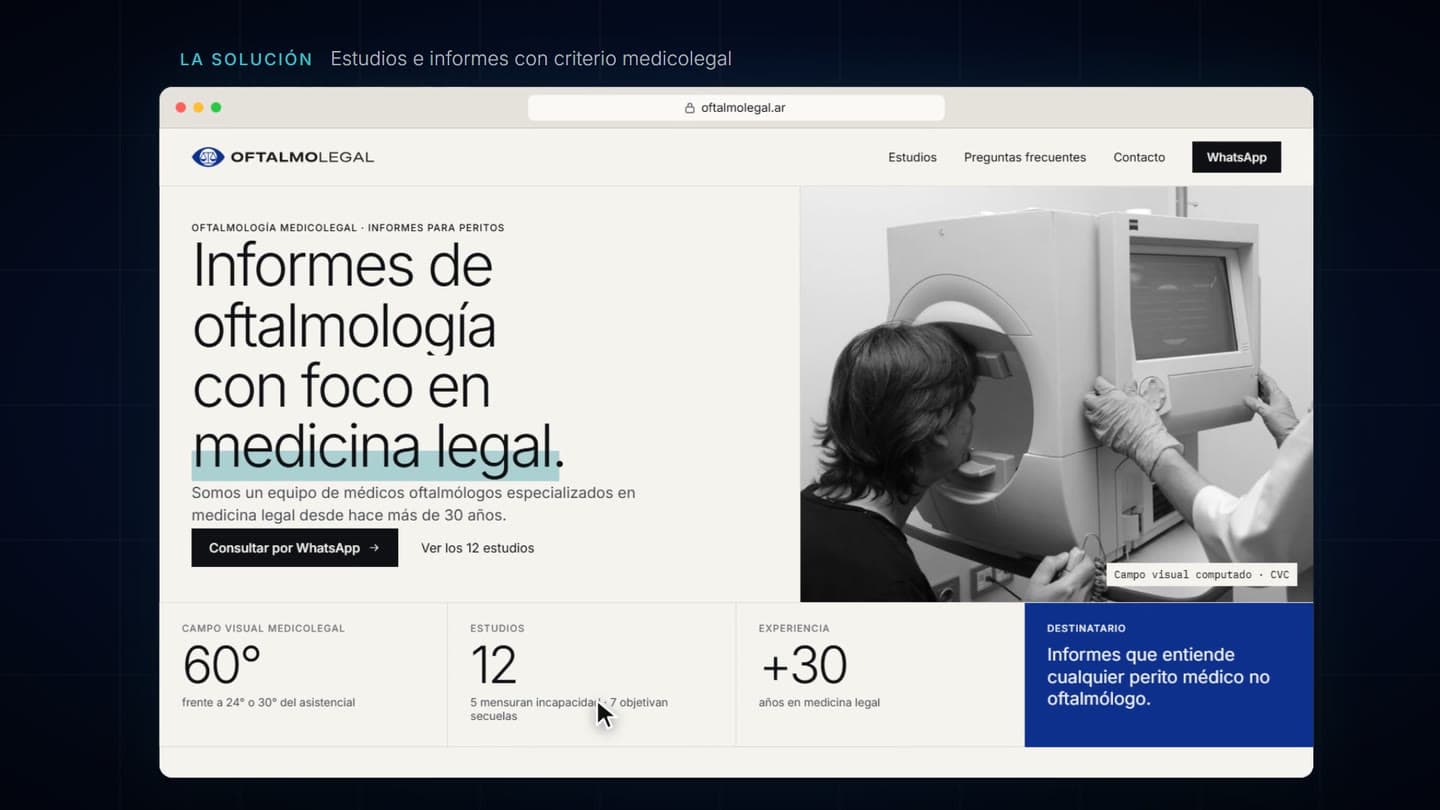
I rebuilt it from scratch as a static site: pages that are already built when you ask for them, with nothing to maintain or update. Hosting, email and the contact form moved to free services. With the new site, the only thing left to pay is the domain: ARS 25,500 a year, about USD 15. 94% less.
But cutting the cost was the easy part. What I cared about most was making the site useful:
- Making the business clear in seconds. OftalmoLegal runs studies with medico-legal criteria, and its core argument is the visual field: the routine test explores 30°, the medico-legal one 60°, and that gap is where defects the other one misses show up. I built an interactive perimeter that shows it with an example: switch from 30° to 60° and the defect appears.
- An original drawing for each study. Twelve animated diagrams —an eye chart, a pressure gauge, a fundus, an evoked potentials wave— made from scratch, with no stock photos or faces.
- Written for whoever is searching. Each study opens by defining what it is, with the acronyms experts use to request it (AV, CVC, FO…), and has its own FAQ. That's what Google values and what AI assistants quote when someone asks them.
- Sharing well. Every page has its own image for WhatsApp and social media.
- Breaking nothing. Addresses are the same as in WordPress, so links already circulating in emails and reports keep working.
- Easy contact. A form with invisible anti-spam, instead of the old "what is 12 + 15?", and the WhatsApp button always at hand.


The numbers
- yearly cost
- −94%
- yearly cost
- until something shows on a phone (was 3.9 s)
- 0.9 s
- until something shows on a phone (was 3.9 s)
- Lighthouse performance (was 70)
- 98
- Lighthouse performance (was 70)
- first load (was 498 KB)
- 126 KB
- first load (was 498 KB)
Measured with Lighthouse on mobile. Accessibility went from 71 to 97. I measured the new site before publishing it, so in production network delay gets added on top.
A commercial, as a bonus
While I was at it, I made a 30-second commercial for social media, built with code from the same data as the site: the phone, the email and the studies come from there, so if something changes, the video gets regenerated with the new data.

What I take from it
- Measure before proposing anything. The report made the decision obvious.
- Expensive doesn't mean well made: paying every year didn't even guarantee the site showed up on Google.
- The most valuable part wasn't the code, it was understanding the business well enough to explain it on one screen.
All notes
All notes →